How Many Miles Is 9 000 Steps? Exact Conversion with Personal Tips
Curious how far 22,000 steps cover? It equals roughly 11 miles.
This uses an average adult stride length of about 2.5 feet. Your actual distance depends on your walking speed and step size.
Walking 22,000 steps covers a large distance. It’s close to traveling from one city neighborhood to a nearby town. For example, 11 miles might take three or four hours of steady walking.
Keep in mind, your exact miles can shift slightly depending on your height and walking style. Taller people usually have longer strides, so their distance per step is more. Shorter people or those taking smaller steps will travel less distance.
Before you guess your distance, check your stride length. It changes the math and helps you track your fitness more accurately. Using a pedometer that adjusts with your personal stride can give better results too.
Key Takeaways
- 22,000 steps generally equal around 11 miles for most adults.
- Stride length varies by height and can change your total miles.
- Measuring your personal stride improves distance accuracy from step counts.
- Averaging 2.5 feet per step works well for many men.
- Women often have a shorter stride, so their distance per step is less.
- Using a smart pedometer helps track your actual walking distance.
1. How Many Miles Are 22,000 Steps Exactly?
Twenty-two thousand steps equal about 11 miles for most adults with average stride lengths. Men typically have a stride length near 2.5 feet.
Women’s average is about 2.2 feet. Using these strides, 22,000 steps multiply out to roughly 11 miles.
Here’s a quick breakdown: at 2.5 feet per step, 10,000 steps equal 4.735 miles. Double that for 20,000 steps, and you get approximately 9.47 miles. Adding 2,000 more steps brings the total close to 11 miles.
For women at 2.2 feet per step, 10,000 steps equal about 4.16 miles. So 22,000 steps come to just over 9 miles.
Multiply your total steps by how long your stride is in feet. Then, divide that number by 5,280 since there are that many feet in a mile. For example, 22,000 steps times 2.5 feet, then divided by 5,280 equals roughly 10.42 miles walked.
Differences in stride usually happen because people are different heights or walk at various speeds. Still, most adults find 22,000 steps equals between 10.5 and 11 miles.
2. How Stride Length Influences Steps-to-Miles Conversion
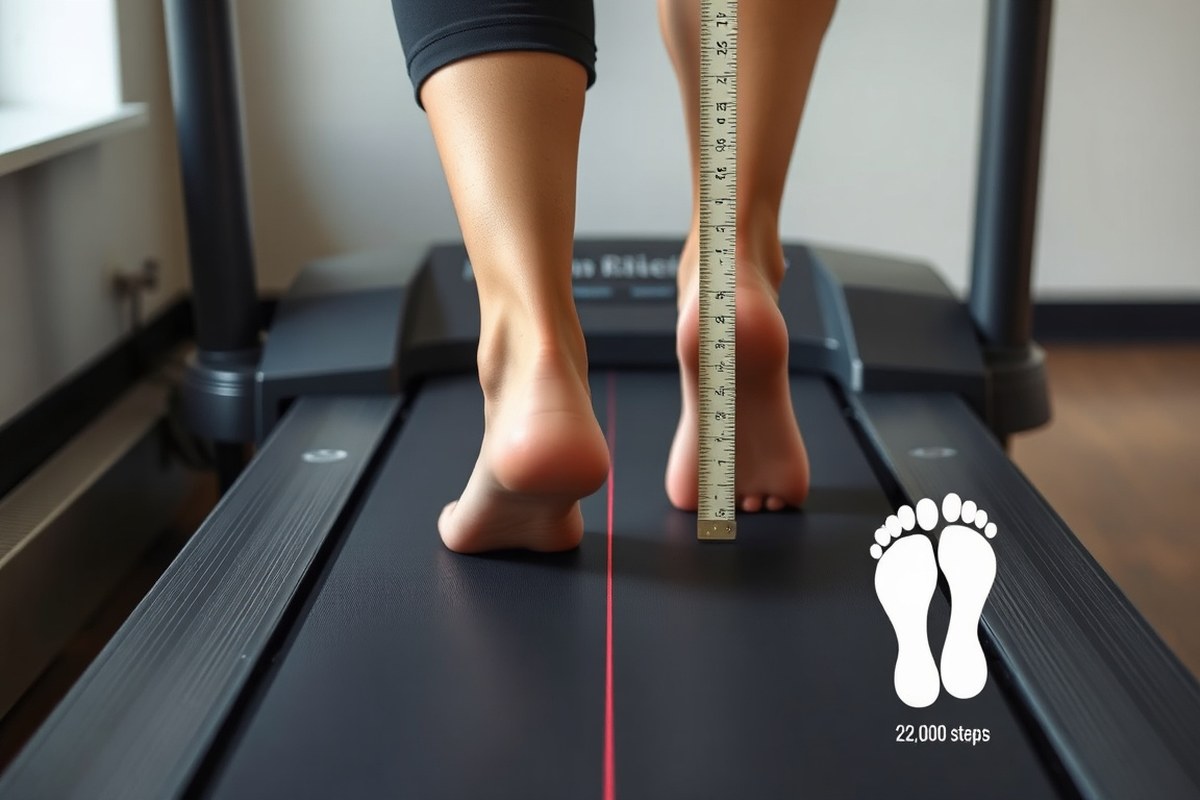
Your stride length determines how far you actually walk in a set number of steps. It varies by person and affects the exact miles in 22,000 steps. Knowing your stride length lets you convert steps into miles more accurately.
What Is Stride Length?
Stride length is the distance between two consecutive steps of the same foot. It depends on your height, walking speed, and leg length. A longer stride covers more ground with fewer steps.
Stride length matters because step counts alone don’t show real distance. For example, two people taking 22,000 steps might walk different miles if their strides differ. Using stride length gives better insight into your actual distance walked.
Average Stride Lengths by Gender and Height
Most adults walk with stride lengths between 24.8 and 31.5 inches, varying by height. Women tend to have shorter strides, about 24.8 to 27.3 inches. Men often range from 28.2 to 31.5 inches.
A 5-foot person usually has a stride around 25 inches, equaling about 2,550 steps per mile. A 6-foot person takes about 2,126 steps per mile. Their stride length is closer to 30 inches.
This is why they take fewer steps per mile. This difference impacts distance measured from step counts.
Relation Between Stride Length and Steps per Mile
Steps per mile equals the total inches in a mile. Divide that by your stride length in inches. This gives you your steps per mile.
Since a mile is 63,360 inches, divide this by your stride to get steps per mile. For example, a 30-inch stride results in about 2,112 steps per mile (63,360 ÷ 30).
To find miles from steps, first multiply your steps by your stride length in meters. Then divide that result by 1,609 to get miles.344. This formula works for any stride length, making your distance calculations more precise.
Measure your stride by walking 10 steps. Measure the total distance covered. Divide that number by 10 to get your average stride.
3. How to Calculate Your Own Distance from Step Count
You can figure out how far 22,000 steps take you by measuring your own stride length. Then, use that stride length to convert your steps into miles with a simple calculation. This works for walking or running.
Measure your stride at the right pace. Make sure to keep it consistent.
Step 1: Measure a Known Distance
Pick a flat, straight spot you can walk along, like a hallway or sidewalk. Measure out a distance of about 30 feet. Use a tape measure or a long ruler.
Find a clear spot to do this. This fixed distance will help you get a good average stride length.
Make sure the area is free of obstacles so you can walk normally. The 30-foot length gives you enough steps to average without taking too long.
Step 2: Count Your Steps over That Distance
Walk the measured 30 feet at your usual pace, counting each step as you go. Do this several times, such as three to five walks, to get a consistent number. Keep the step count for each walk and note it down for accuracy.
Use your natural walking or running steps depending on which pace you want to measure. This lets you know the actual step length for either walking or running.
Step 3: Calculate Step Length and Convert Steps to Miles
Calculate your step length by dividing the total distance by the number of steps you took. For example, it took 15 steps to cover 30 feet. Your stride length is 30 divided by 15.
That means 2 feet per step. Use the average from all tries to improve precision.
To find miles from steps, multiply step length by step count. Then convert the total feet to miles. Use 5,280 feet per mile for the conversion.
Since 1 mile is 5,280 feet, divide the total feet by 5,280 for miles. For 22,000 steps at 2 feet each, multiply 22,000 by 2.
Then divide by 5,280. The result is about 8 miles.33 miles.
- Measure a 30-foot distance on a flat surface.
- Mark your start and end points clearly.
- Walk the distance at your normal walking or running pace.
- Count your steps during each walk.
- Repeat 3-5 times to average the step count.
- Calculate average step length by dividing 30 feet by average steps.
- Multiply your step length by your total steps (like 22,000).
- Divide total feet by 5,280 to get your miles.
4. How Height and Gender Affect Your Walking Distance
Taller people naturally cover more distance with each step. That happens because stride length tends to grow with height. Someone who is 6 feet tall usually takes longer steps.
This is different from someone who is 5 feet tall. Taller people tend to have longer strides.
Men and women have different average stride lengths. This happens mainly due to height differences. Body structure also affects stride length.
Men’s strides generally average about two to four inches longer. This affects how far 22,000 steps will carry each person.
Stride length affects how many miles you get from 22,000 steps. Here’s a useful table showing common walking distances, plus the step counts to hit them.
It shows how many steps it takes to walk versus run each distance. Steps per mile vary based on your stride length.
| Distance | Miles | Walking Steps | Running Steps |
|---|---|---|---|
| 1 mile | 1.00 | 2,112 | 1,348 |
| 5K | 3.11 | 6,562 | 4,189 |
| 10K | 6.21 | 13,123 | 8,379 |
| Half marathon | 13.11 | 27,687 | 17,677 |
| Marathon | 26.22 | 55,374 | 35,354 |
The average walking steps per mile here is about 2,112, which fits most adults. A taller person might need closer to 1,900 steps per mile. That means 22,000 steps for them could cover about 11.5 miles, more than the 10 miles for someone shorter.
Knowing your height and gender helps you adjust your estimate. You can track your step length yourself. Measure how far you walk over some steps.
Then divide distance by the number of steps. Divide the distance by the number of steps. That gives you your actual step length for more precise mile conversion.
5. How Long Does It Take to Walk 22,000 Steps?
Walking 22,000 steps takes roughly between 3.5 and 5 hours. The exact time depends on your walking speed and factors like terrain or fitness. Knowing how long it takes helps you fit walks into your day better.
Average Walking Speeds and Steps per Minute
Most adults walk about 3 miles per hour. That equals roughly 100 to 110 steps each minute. A casual pace usually falls near 100 steps per minute.
Brisk walking hits 120 steps or more. These numbers help estimate time based on how fast you move.
For example, walking at 3 mph means you take close to 2,000 steps in 20 minutes. Speeds can vary depending on your age, health, and even mood. It’s useful to measure your usual walking pace with a stopwatch for more accuracy.
Time Estimates for 22,000 Steps at Different Paces
At 100 steps per minute, you walk 22,000 steps in 220 minutes. That equals 3 hours and 40 minutes.
Brisk walking at 120 steps per minute cuts this time to about 3 hours. These are rough averages and depend on your steady pace.
Walking faster than 3 mph shortens the time, but requires more energy. Moving slower, around 80 steps per minute, takes about 4 hours to finish.5 or 5 hours. Being realistic about your fitness helps prevent scheduling too much walking time.
Track your pace with a phone app to get better time estimates for long walks.
Factors Influencing Walking Duration
Terrain changes your walking speed a lot. Hilly or uneven paths slow you down compared to flat sidewalks. Weather matters too: hot or windy days can force you to take breaks.
Fitness level plays a big role. Someone in good shape can sustain a brisk pace for hours.
Beginners might need frequent breaks and walk slower. Loading yourself with a backpack or walking with small kids also lengthens total walking time.
6. Calories Burned Walking 22,000 Steps
Walking 22,000 steps burns roughly between 880 and 1,100 calories. The exact number depends on your weight and walking speed.
A 155-pound person walking briskly burns about 402 calories per 10,000 steps. So 22,000 steps roughly doubles that.
You burn fewer calories if you weigh less or walk slower. For example, a 125-pound person burns about 320 calories per 10,000 steps. Walking 22,000 steps at that rate burns close to 700 calories.
A person weighing 185 pounds might burn about 475 calories per 10,000 steps. For 22,000 steps, that adds up to around 1,045 calories burned.
Walking pace influences calorie burn too. Walking briskly takes more energy than a casual stroll.
At a moderate pace, a 155-pound person burns around 400 to 500 calories per 10,000 steps. Slow walking could cut that number by 20-30 percent.
Here’s a quick comparison to help you see how weight and pace play out:
| Weight (lbs) | Calories per 10,000 Steps | Calories for 22,000 Steps |
|---|---|---|
| 125 | 320 | 704 |
| 155 | 400 | 880 |
| 185 | 475 | 1,045 |
Understanding calories burned helps with weight loss. Burning 880 calories by walking 22,000 steps equals nearly half a pound of fat lost.
You need a calorie deficit of 3,500 to lose one pound. So, walking large steps frequently can add up.
Keep in mind that metabolism rates vary. Some people burn calories more efficiently than others.
Measure your pace, weight, and height for a better calorie estimate. Use a step tracker or a walking calorie calculator to get results.
7. Common Mistakes in Estimating Steps to Miles and How to Avoid Them
Step counters often show different mileages because they assume a set step length. That length may not match your actual walking stride. These estimates often use averages that don’t fit everyone’s height or pace.
Many people make the mistake of using a generic step length, like 2.5 feet or 0.75 meters. This can cause errors since your step might be shorter or longer.
For example, shorter people often have step lengths closer to 0.6 meters. Taller people can reach over 0.8 meters.
You can fix your distance estimates by measuring your own step length. Walk a known distance, like 100 feet, counting steps along the way.
Then divide that distance by the number of steps to find your average step size. Plug this into the formula: Miles = Steps × Step Length (meters) ÷ 1,609.344.
Some other common errors happen when you:
- Use step counters that only count steps but don’t track stride.
- Ignore changes in stride from walking faster or slower.
- Fail to update step length if your walking style changes over time.
- Assume walking on flat ground is the same as walking uphill or downhill.
- Let device syncing errors happen by not calibrating regularly.
You can adjust for these by recalibrating your device monthly or when you notice big differences. Some apps like iPhone Steps or Apple Watch track your workouts. They use this data to figure out your actual step length.
This measurement happens automatically during your exercises. They update your stride from actual walks, making your miles more accurate.
Correcting these errors takes a few minutes and simple tools, just measure a known distance. It costs nothing beyond your time.
After this, your step-to-mile conversions will match your real-world walks more closely. This helps you track progress and set goals that make sense for you.
8. Differences Between Walking and Running Step Conversions
The number of steps you take in a mile changes whether you are walking or running. Walking usually means shorter steps, about 2.35 feet long, or roughly 2,250 steps per mile at a 20-minute mile pace. Running strides stretch longer.
Jogging at 12 minutes per mile lowers steps to about 1,875 per mile. At this pace, your stride length is close to 2 feet. That changes how you count steps versus distance.82 feet.
Running faster cuts your steps even more. At a 6-minute mile pace, you take about 1,064 steps per mile. Each step is nearly 5 feet long then.
You can’t use the same step-to-mile formula for running that you use for walking. Running stride length changes the math. Count your stride length in feet, then divide 5,280 (feet in a mile) by that number.
For walking, if your stride is 2.35 feet, you get about 2,250 steps per mile. For a moderate run with a 3.3-foot stride, it’s about 1,600 steps in a mile. This difference is important to know.
Using walking steps per mile will make your running distance inaccurate. Your step length changes with speed.
For example, 22,000 walking steps might equal roughly 9.8 miles. But the same step count running at an 8-minute mile pace would cover around 15.7 miles. The table below shows an easy comparison:
| Pace | Steps per Mile | Stride Length (feet) |
|---|---|---|
| Walking (20 min/mile) | 2,250 | 2.35 |
| Jogging (12 min/mile) | 1,875 | 2.82 |
| Moderate Run (10 min/mile) | 1,600 | 3.30 |
| Run (8 min/mile) | 1,400 | 3.77 |
| Fast Run (6 min/mile) | 1,064 | 4.96 |
Using the wrong step count for your activity can seriously skew your distance and pace tracking.
9. Tools and Calculators to Accurately Convert Steps to Miles
Several free tools can help you convert steps to miles. Most online calculators ask for your step count and stride length. They use a simple formula: multiply your steps by stride length, then convert that to miles.
Fitness trackers estimate distance based on your steps and stride length. Some devices use an average stride length like 2.5 feet, which fits most adults. Others learn your personal stride length by tracking your GPS distance during walks.
Apps that adjust for your specific stride length give you more accurate distance results. You can enter your height or manually measure your stride length. Better apps update this info over time as your walking style changes.
- MapMyWalk: Free app that lets you track steps and custom stride lengths.
- Google Fit: Shows steps and calculates miles using your height or set stride.
- Step to Distance Converter websites: Enter steps and stride length for quick results.
- Pacer Pedometer: Free app with easy stride length entry and step tracking.
- Fitbit app: Syncs with devices and adjusts distance based on your measured stride.
Choose a tool that fits your needs and device. Measure your stride length by walking 10 steps and dividing your distance by 10.
Enter this number for better accuracy than defaults. Check your app or device settings and update your stride when you notice big distance errors.
Many free tools offer decent accuracy if you provide correct stride data. Without it, apps use averages that may not fit your body. These averages can be wrong if you’re taller or shorter than most people.
This causes less accurate step or distance counts. Tracking errors can happen if your walking speed or terrain changes your stride length during walks.
Your Step-to-Mile Walking Plan
Use this simple plan to track and understand your 22,000-step journey. It’s designed to help you see real progress and get comfortable with estimating your walking distance.
- Day 1: Walk 10 steps on flat ground. Measure the distance walked. This gives your stride length. Divide the total feet by 10 to get your average step length.
- Day 2: Calculate your personal miles for 22,000 steps by multiplying your step length by 22,000. Convert feet to miles by dividing by 5,280. Check if this matches your walking tracker’s estimate.
- Week 1: Walk 5,000 steps with a GPS app or pedometer. Compare the app’s distance to your calculation. Adjust your stride length if the difference is over 5%.
- Week 2: Increase your walk to 11,000 steps. Track the time it takes. Monitor your pace and increase or decrease time as needed to stay comfortable.
- Week 3: Try walking outdoors and indoors. Note how terrain affects your step length or pace and adjust your calculations accordingly.
- After 3 weeks: Walk the full 22,000 steps using your personal stride length and time track. Note your total time and calories burned from your tracker or app.
- Ongoing: Update your stride length every few months or as your fitness improves. It keeps your step-to-mile conversion accurate over time.
Frequently Asked Questions
How Does Walking Speed Affect How Many Miles 22,000 Steps Cover?
Walking speed does not change the distance 22,000 steps cover. Your stride length and step count decide the miles you cover.
Speed doesn’t change the distance, but it affects workout intensity. Faster pace burns more calories.
Can Walking Uphill Change the Distance Covered in 22,000 Steps?
Walking uphill does not change the total distance for 22,000 steps. Your stride can get shorter when walking uphill.
Still, steps add up to about 11 miles. This estimate is based on your stride length.
Does Carrying Weight Impact How Far 22,000 Steps Will Take You?
Carrying weight doesn’t change the distance of 22,000 steps. Distance depends on your step length during a walk.
Carrying extra weight can make walking harder. It may also slow your pace.
Are Indoor Treadmill Steps the Same as Outdoor Steps for 22,000 Steps Distance?
Treadmill steps generally count the same for distance as outdoor steps. On a treadmill, your stride might change just a bit.
This can slightly shift the total miles for 22,000 steps. The difference is usually small.
How Does Age Influence the Distance for 22,000 Steps?
Age can reduce your stride length, slightly shrinking the distance of 22,000 steps. Older adults might cover a bit less than 11 miles due to shorter steps.
Final Thoughts
22,000 steps usually equals about 10 miles. But your exact distance depends on your stride.
Measure your steps and pace to get clearer walking goals. Start tracking today and see how your distance shapes up.